The Amazon Is Approaching a Savanna Tipping Point
A single large tree in the Amazon releases a thousand litres of water into the atmosphere every day. Multiply by 390 billion trees across 5.5 million square kilometres and you get a hydrological engine of planetary scale. The Amazon does not merely receive rain. It generates roughly half its own — pumping moisture skyward through evapotranspiration and recycling it five or six times as the air mass moves from the Atlantic coast toward the Andes.
This engine feeds agriculture as far south as Argentina. It stabilizes the climate of an entire continent. It stores carbon equivalent to 15–20 years of current global CO₂ emissions. It holds more than 10% of all known species on Earth.
It is also, by the best available evidence, beginning to fail.
What Is the Amazon Tipping Point?
In 2007, a team led by Gilvan Sampaio and Carlos Nobre ran simulations asking how much of the Amazon could be cleared before the rainfall-recycling system broke down. Their answer: 40% deforestation would cause a sharp, basin-wide drop in rainfall. In 2018, the late Thomas Lovejoy and Carlos Nobre lowered the estimate. They argued 20–25% deforestation — combined with rising temperatures and an accelerating fire regime — could be enough.
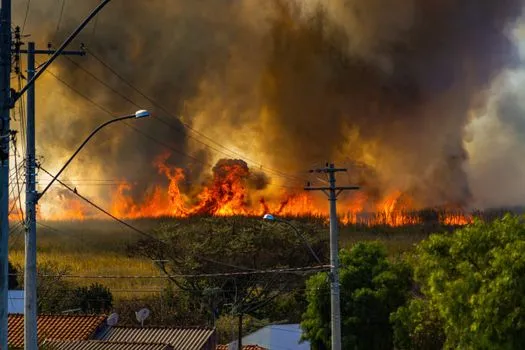
The mechanism is straightforward. Trees transpire water. That water becomes rainfall downwind. Remove enough trees and the rainfall declines. Less rain means more drought stress. Stressed trees die, or burn, which removes more trees — reducing transpiration further. The system crosses a feedback threshold where the forest can no longer sustain the humidity it requires to be a forest.
The neighbouring Cerrado — a vast savanna-forest mosaic south of the Amazon — offers a preview of what that looks like. The Cerrado was never rainforest, but it demonstrates that under the same broad climate conditions, two very different ecosystems can exist as stable states. Cut the Amazon and it may not grow back as Amazon. It may grow back as Cerrado. Or as degraded grassland.
| Threshold | Value | Source |
|---|---|---|
| Deforestation tipping point | 20–25% | Lovejoy & Nobre (2018) |
| Sharp rainfall collapse | 40% | Sampaio & Nobre (2007) |
| Global warming threshold (dieback) | 3.5°C (range 2.0–6.0°C) | Armstrong McKay et al. (2022) |
| Carbon released — partial dieback | 30 Gt C | Armstrong McKay et al. (2022) |
| Carbon released — total dieback | 75 Gt C | Armstrong McKay et al. (2022) |
| Total carbon stored in Amazon | 150–200 Gt C | Flores et al. (2024) |
Where Are We Now?
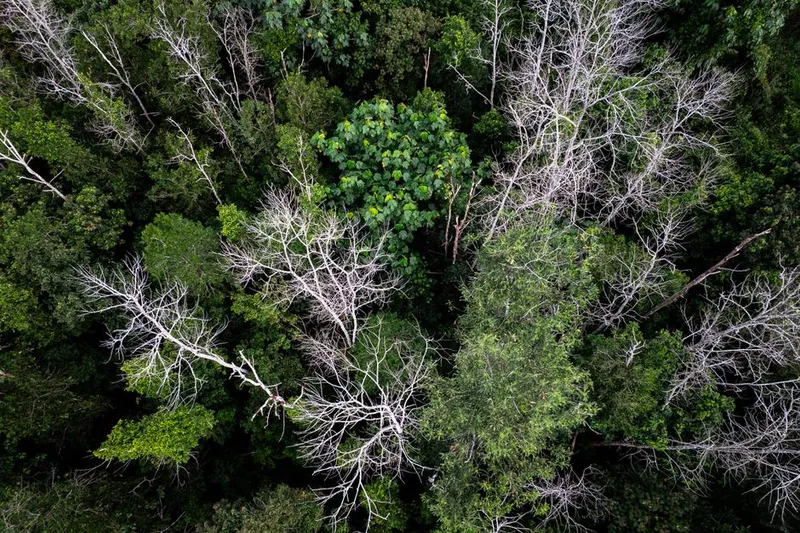
The Amazon has lost roughly 17–20% of its original forest cover. Another 6% is highly degraded. Taken together, about a quarter of the biome is compromised.
| Year | Deforestation (Brazilian Amazon, km²) | Context |
|---|---|---|
| 2004 | 27,772 | All-time peak |
| 2012 | 4,571 | Historic low — PPCDAm enforcement working |
| 2019 | 9,762 | First Bolsonaro year — enforcement dismantled |
| 2021 | 13,038 | Bolsonaro-era peak — highest since 2006 |
| 2023 | 9,001 | Lula — enforcement resumed, decline begins |
| 2024 | 6,288 | Continued decline — but fires surged |
| 2025 | 5,264 | Lowest since 2012 |
The chainsaw trend under Lula is encouraging. The problem is that deforestation is no longer the only driver. In 2024, fires — not chainsaws — caused 66% of Brazil’s forest loss, a more than sixfold increase from 2023. 6.7 million hectares of tropical primary forest were lost globally in 2024 — nearly double 2023 — and Brazil accounted for 42% of that total. The Amazon experienced its highest tree cover loss since 2016.
The 2024 Drought
The Amazon’s rivers are its highways. In 2024, those highways ran dry. The Rio Negro at Manaus fell to its lowest level in 121 years of measurement. The Solimões, Madeira, and Amazon rivers all hit record lows. More than 420,000 children were affected across Brazil, Colombia, and Peru — schools and health clinics cut off, clean water inaccessible, food supplies stranded. Over 120 Amazon river dolphins died in Tefé Lake in 2023 when water temperatures exceeded 39°C; the 2024 drought compounded the crisis.
This was not an anomaly. It was the fifth “once-in-a-century” drought in 20 years: 2005, 2010, 2015–16, 2023, 2024. The World Weather Attribution group found climate change is the primary driver. The droughts are not natural variability. They are the new climatology.
The Fire Feedback Loop
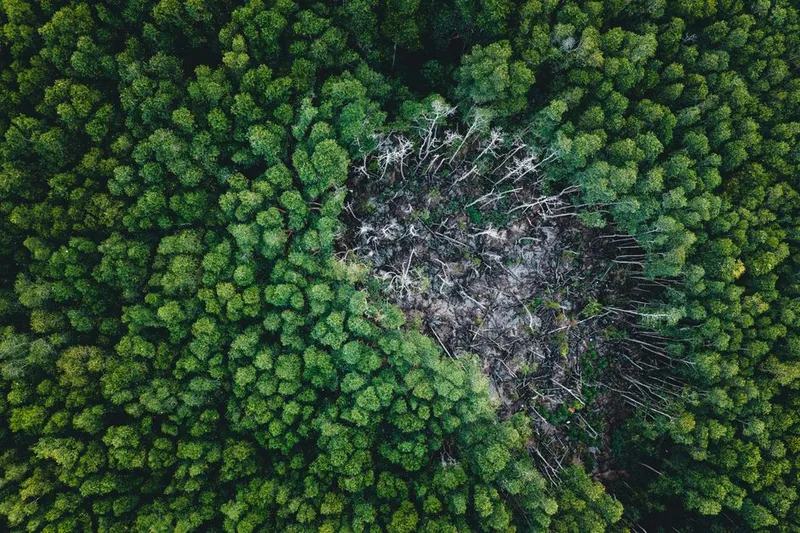
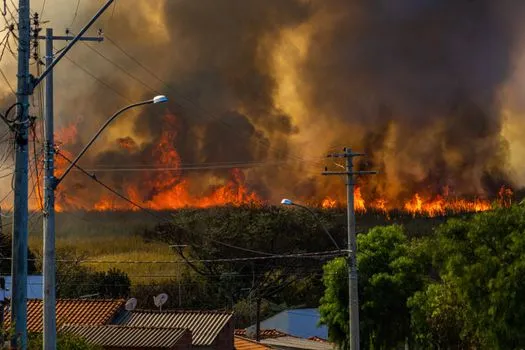
For most of its history, the Amazon did not burn. The forest was too wet. Fire was rare and when it occurred, it stayed small.
The mechanism that changed this is simple enough to describe in four sentences:
Deforestation and logging open the canopy. Sunlight reaches the forest floor and dries it. Fires set on adjacent pasture or cropland — intended to clear brush or renew grazing — breach the forest edge. Large, slow-growing trees with thin bark and no fire adaptation die. Their deaths open the canopy further, drying the understory more, making the next fire worse.
The cycle accelerates. A study by Paulo Brando and colleagues (2014, PNAS) found that a single drought-fire event could increase tree mortality by five times the baseline rate. Repeated fires transform forest structure. Grasses and pioneer species move in — and these burn far more readily than closed rainforest. The fire regime itself can “tip” from localized burns to uncontrollable mega-fires.
What Happens When It Flips
1. Regional Rainfall Collapse
A deforested Amazon produces 20–30% less rainfall across the basin. The eastern and southern Amazon — already the driest regions — are hit hardest. These are precisely the agricultural frontier zones where soy and cattle production are concentrated.
The “flying rivers” — atmospheric moisture streams that carry Amazon rainfall south — weaken. This affects the Pantanal (the world’s largest tropical wetland), the La Plata river basin, and agricultural regions as far south as Uruguay and northern Argentina. Brazil is the world’s largest exporter of soy, beef, coffee, sugar, and orange juice. All of these depend on rain that the Amazon generates. Deforestation for agriculture destroys the rainfall that agriculture depends on. The World Bank calls this “agro-suicide.” Their 2023 report estimated economic losses from deforestation could be ~7× the value of all commodities produced on the cleared land.
2. The Carbon Bomb
Cross the tipping point and the Amazon flips from net carbon sink to net carbon source. This is not a projection — in parts of the southeastern Amazon, it has already happened.
| Region | Carbon status (2010–2018) | Source |
|---|---|---|
| Southeastern Amazon | Net carbon source | Gatti et al. (2021), Nature |
| Northeastern Amazon | Roughly neutral | Gatti et al. (2021) |
| Southwestern Amazon | Small net sink | Gatti et al. (2021) |
| Western Amazon | Net carbon sink | Gatti et al. (2021) |
The Amazon stores 150–200 billion tonnes of carbon. A full dieback would release the equivalent of 15–20 years of current global CO₂ emissions on top of everything else humanity is already emitting. It would, in practical terms, make the Paris Agreement targets unachievable.
3. The Biodiversity Cost
The Amazon holds more than 10% of all known species on Earth: 15,000+ tree species, 2.5 million insect species, 2,200 fish species, 1,294 bird species, 427 mammals. A single hectare in the central Amazon can contain more than 300 tree species — more than exist in all of Britain.
A 2019 analysis found that up to 50% of Amazon tree species could become threatened by 2050 through the combined effects of deforestation, degradation, and climate change. Species loss is irreversible on any timescale that matters to human civilization. Evolution operates in millions of years. We are operating in decades.
Is It Inevitable?
Four things are true simultaneously — and together they define the arena in which this plays out.
1. Deforestation is dropping.
The Lula government has reversed much of the Bolsonaro-era surge. 2025 deforestation was roughly one-third the 2021 peak. Enforcement agencies are functioning again. IBAMA levied R$365 million (US$64 million) in fines on cattle companies — including JBS, the world’s largest meat packer — for involvement in illegal deforestation in October 2024. The 2006 Soy Moratorium proved supply-chain interventions work: only 1% of new soy expansion occurred at the expense of forest in the following eight years. Brazil has done this before. The 2004–2012 decline in deforestation reduced annual loss by more than 80%.
2. Indigenous territories work.
The Amazon contains 3,344 formally acknowledged Indigenous territories. Deforestation rates inside them are 2–3× lower than outside. In Peru, legal land titling for Indigenous communities reduced deforestation by 75%. Indigenous land rights are the single most effective and cost-efficient forest protection mechanism available — and they cost a fraction of technological or enforcement-only approaches.
3. But climate change is accelerating independent of chainsaws.
Even if deforestation drops to zero — and no credible scenario has it doing so — the warming and drying already locked in from global emissions will continue to stress the forest. A 2025 study in Nature Communications found that deforestation-induced drying lowers the Amazon’s climate threshold: the more forest we clear now, the lower the global warming at which dieback becomes inevitable. Two stressors are interacting in the worst possible direction.
4. The resilience is already draining.
The 2022 Boulton, Lenton & Boers study — using satellite-derived vegetation data from 1991 to 2016 — found that more than three-quarters of the Amazon rainforest has been losing resilience since the early 2000s. This loss is greatest in drier regions and in areas closer to human activity. The 2024 Flores et al. analysis found that 10% to 47% of the Amazon could be exposed to compounding disturbances by 2050 that trigger ecosystem transitions.
The honest assessment: zero deforestation is achievable. Brazil has demonstrated that before. But preventing the Amazon’s transition in a warming world requires both zero deforestation and global emissions reductions consistent with 1.5°C. Neither condition is currently being met.
The Amazon tipping point is not a single switch that flips on a Tuesday. It is a cascade of regional transitions — the southeastern forest already emitting more carbon than it absorbs; the eastern margins fraying into grassland; the fire regime accelerating beyond human control; the rainfall pump weakening year by year. At some point in this cascade, the word “rainforest” no longer describes the system. What replaces it will store less carbon, support fewer species, and generate less rain. South American agriculture will adjust to a drier continent. The global carbon budget will tighten further. And the planet will have lost one of its primary life-support systems — not to a meteorite or a supervolcano, but to a combination of cattle, soy, fire, and heat.
The numbers do not doom-scroll. They simply sit there, unambiguous. The forest is at roughly 17–20% deforested. The threshold sits at 20–25%. The margin is anywhere from zero to five percentage points.
This post is part of a broader series on the planetary systems that keep Earth habitable. For the full picture — all nine planetary boundaries, their current status, and what happens when they interact — read Planetary Boundaries Explained and A Letter to Humanity.
Sources
- Lovejoy, T.E. & Nobre, C. (2018). Amazon Tipping Point. Science Advances
- Boulton, C.A., Lenton, T.M. & Boers, N. (2022). Pronounced loss of Amazon rainforest resilience. Nature Climate Change
- Flores, B.M. et al. (2024). Critical transitions in the Amazon forest system. Nature
- Gatti, L.V. et al. (2021). Amazonia as a carbon source. Nature
- Armstrong McKay, D. et al. (2022). Exceeding 1.5°C could trigger multiple tipping points. Science
- Brando, P.M. et al. (2014). Drought–fire interactions and Amazon tree mortality. PNAS
- Brienen, R.J.W. et al. (2015). Long-term decline of the Amazon carbon sink. Nature
- Lapola, D.M. et al. (2023). The drivers and impacts of Amazon forest degradation. Science
- Nepstad, D. et al. (2006). Inhibition of Amazon deforestation by parks and Indigenous lands. Conservation Biology
- Wikipedia: Deforestation of the Amazon rainforest
- World Resources Institute — 2024 forest loss data
- Attia et al. (2025). Deforestation-induced drying lowers Amazon climate threshold. Nature Communications